
Regency Scandal at Athelhampton House & Gardens
Today is the anniversary of the death of William Pole-Tylney-Long-Wellesley, 4th Earl of Mornington, which is something that plenty of people would have had cause to celebrate (including his wife, if he hadn't arguably caused her death!).

Notorious for his dissolute lifestyle, William was many things, but nice doesn't seem to have been one of them. Nephew of the Duke of Wellington, William was a big spender, drinking and gambling heavily to amuse himself, as well as being something of a womaniser. Despite this lifestyle, he might have stayed out of the public spotlight if it weren't for who he chose to court, back when he was plain William Pole-Wellesley.
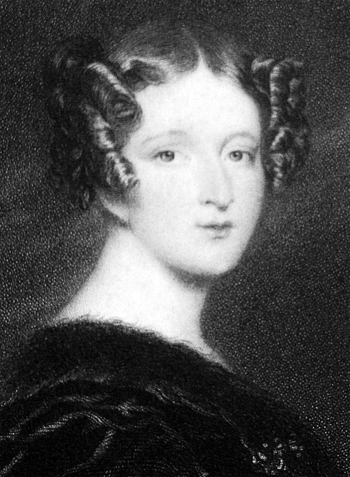
Catherine Tylney-Long was young, beautiful, and (most importantly) rich. Really rich. After the death of her brother and then her parents, she had inherited an income of £40,000 a year (Mr Darcy had nothing on her!). Along with this income came all manner of manor houses: Wanstead, in Essex, was the principal one, but others were scattered all over the country, and included Athelhampton House & Gardens (or, at least, three quarters of it).

Being so wealthy, naturally there were huge amounts of speculation about who she would marry. The Georgian concepts of celebrity carried into the 19th century, with common women featuring heavily in magazines and newspapers if they were deemed to be "interesting" enough, by virtue of money or lifestyle. Actresses and courtesans were followed, written about, and caricatured just as much as the royal family, and Catherine met the same fate.

Pictured at the centre here, she is surrounded by hopeful men wanting to marry her. She's shown on a red velvet throne, fringed with gold, with gold fringed steps leading up to it. Each step is labelled with an age and a stage of life, from bottom to top: 10, Infancy, 15 Puberty, 20 Womanhood, 25 Discretion, 30 Old Maidism. On either side of the steps are cornucopias throwing forth gold coins. Catherine herself is also made of gold, and is overshadowed by a dark cloaked, crowned skeleton. She seems to be throwing her hands up in despair.
Her suitors include William Duke of Clarence, the future King William IV, on the right hand side of the steps, dressed in white and blue and gesturing towards her. With the other hand, he holds back another suitor - a man with a huge moustache, dressed in green with a red sash and an insignia of a yellow skull and cross bones. This particular man is Baron Ferdinand de Géramb, shown here passing secrets to Napoleon, the man in the impossibly large hat and pair of boots behind him.

Behind William, standing on a box labelled "Bushy Money Chest" is Dorothea Bland, or Mrs Jordan, William's mistress, and mother of 10 of his children.

The most admired comic actress of her time, she was also competent in Shakespearian roles, though she met with less success playing women of higher social standing. She lived with William at Bushy House (hence the title on the money chest!), but it's clear that the relationship between them had fallen apart by 1811, quite possibly thanks to William's pursuit of Catherine.

While in the caricature, she's misquoting Shakespeare - "False faithless perjured Clarence," she says, rather than the quote from Richard III "False fleeting perjured Clarence," it seems that she makes her opinions on William's pursuit of Catherine quite clear elsewhere - William describes her as "becoming more moderate," to his friend Colonel John McMahon, who seems to be mediating between the two.

It seems William's favourite daughter Sophia also had strong feelings against his prospective marriage to Catherine initially - he writes "I have satisfied Sophia, and she is quite reconciled to my marriage." In the same letter, William seems hopeful of success in the match between him and Catherine - she has asked him to "get rid of Colonel Swain," and he seems to be reading this as her being interested in him instead.
On the left hand side of the image are four more suitors. Closest to Catherine, wearing a red coat and kneeling on a red cushion, is Sir Lumley St George Skeffington, 2nd Baronet. A noted dandy and fop, who was consulted by the Prince Regent when it came to his clothing, and who invented the colour "Skeffington Brown," he was also a playwright, though for the most part we have only the titles of his plays surviving.
Just behind him, in black and gold, wearing a lace collar and cuffs, Elizabethan style breeches, and a crowing cockerel on his head, is Robert "Romeo" Coates, an amateur actor. The crowing cockerel denoting him is a reference to his crest - a crowing rooster, with the motto "while I live I'll crow."
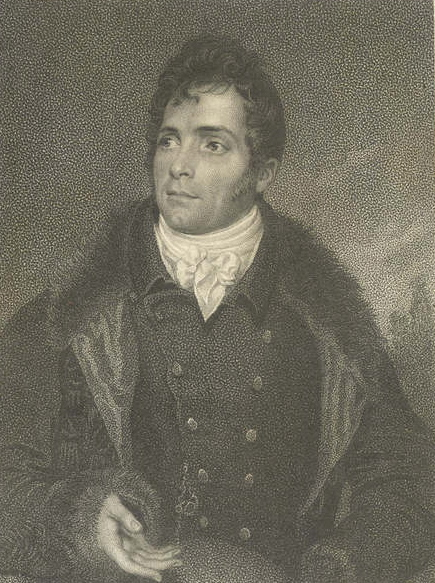
He had an incredibly grand idea of his own acting ability, but between his bizarre costumes, habit of repeating scenes that he liked two or three times in one night (particularly dramatic deaths), and tendency to make up new dialogue and scenes mid-show, in addition to his poor abilities as an actor, audiences flocked to mock him rather than to take him seriously. The Baron de Geramb, shown also in this caricature, was one of his foremost supporters, and even the future George IV - William's brother - was known to attend his performances.
His fame, and people's desire to witness Coates's truly awful acting, was beyond compare, with thousands flocking to see his performances. Quite what Catherine made of him, it's impossible to say.
Behind the two kneeling figures are two more men, dancing to the music of a jester playing the fiddle with his hat covered in bells. The man closer to Catherine is in a green coat, while the man furthest from Catherine, on the edge of the picture, is in purple. At their feet is a piece of paper on which is written "Copy of verses on Pole's Dancing," and in the pocket of the man in the purple coat is a slightly illegible piece of paper possibly addressed to Lord KIL. Based on the appearances of the two men in the caricature, it seems likely that the man in the purple coat is William Pole-Wellesley. The crowned and cloaked skeleton seems to be threatening the two dancing men with a spear.
Despite being nowhere near the centre of this caricature, and not particularly seeming to pay attention to Catherine in the same way as the other suitors, William Pole Wellesley was ultimately successful, marrying Catherine on the 14th of March 1812.


