top of page

News from Athelhampton House & Gardens.

Search

Romeo and Juliet Outdoor Theatre at Athelhampton House & Gardens

Nearly 200 years ago, the owner of Athelhampton House & Gardens, the fabulously wealthy Catherine Tylney Long, was courted by Robert "Romeo" Coates, an actor famed for his performances as Romeo. This July, come and see Romeo and Juliet performed as outdoor theatre at Athelhampton House & Gardens.


Back in the early nineteenth century, Athelhampton House & Gardens were owned by the wealthiest commoner in England: Catherine Tylney Long. As a woman with a fabulously large fortune, Catherine was the object of admiration to many men who wanted to marry her. Her youth and beauty were certainly attractive, but her vast wealth was almost certainly the biggest draw.
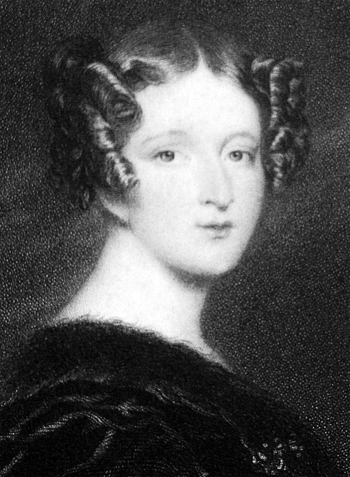

A black and white etching of a young, pale woman turning to her right to face the viewer. She wears fashionable regency ringlets in her hair, and her black dress is lacking in any notable detail.
Catherine Tylney-Long, Unknown Artist

One of her suitors was Robert Coates, also known as "Romeo" Coates. Born in the West Indies, he inherited a lot of money (and a large collection of diamonds) from his father, a plantation owner, and within a year of inheriting had begun to use his wealth to enable him to perform on stage, in leading roles.
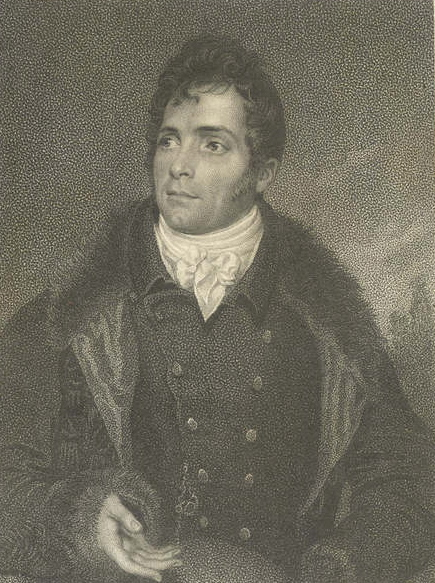

A black and white etching of a young man with fashionably tousled regency hair. He is facing towards the viewer but looking slightly to his right. His overcoat has a fur collar and cuffs, and is worn over a dark double breasted coat. He wears a white cravat.
Robert "Romeo" Coates, Unknown Artist

His favourite, and one of his earliest roles, was as Romeo. For this part, he designed his own costume, with a flowing sky blue cloak with sequins, red breeches, and a plumed opera hat. His large collection of diamonds came in useful here - they decorated most of his clothes. Unfortunately, however, his clothes were too small for him, which meant that even with him making very small movements, the seat of his breeches split part way through the performance.


A caricature of Coates as Romeo. On the left hand side of the image, Shakespeare can be seen, saying "Oh Romeo! Romeo! wherefore art thou Romeo?" with the word "thou" underlined. In the centre, reclining on his back on a chaise lounge, is Coates, dressed in a peculiar cross between regency and elizabethan dress. He holds a cockerel on top of him, and is saying "oh heavy lightness! serious vanity. mis-shapen chaos of well seeming forms!" Discarded around him is a hat decorated with plumes of feathers, a sword, and a diamond necklace. On the right hand side is depicted his dreams, featuring people with chickens bodies or chickens heads. A woman with a chicken's body, wearing a ruff, is saying "Come hither Man I see that thou are poor. Hold, theres forty Ducats." Behind her is an armoured knight with a chickens head, and she appears to be talking to a chicken in ancient Greek or Roman dress. Beneath the dream, at the foot of the bed, is a pair of chickens facing each other, the left hand one black and crowned, with a sword in its beak, and the right hand one white. Between their heads in the background is a theatrical mask. The whole is titled "An Amateurs Dream."
The Caricaturist General, Robert Coates, 1812

His farcical first performance also included him offering snuff to the occupants of one of the boxes mid scene, while for Romeo's death, he placed his hat upon the ground as a pillow, and dusted the stage with his dirty handkerchief before lying down. Having acted out Romeo's death twice, he was about to attempt it a third time before Juliet came back to life and stopped him. At the end of the performance, he came back on stage with a crowbar and tried to pry open the Capulet tomb.
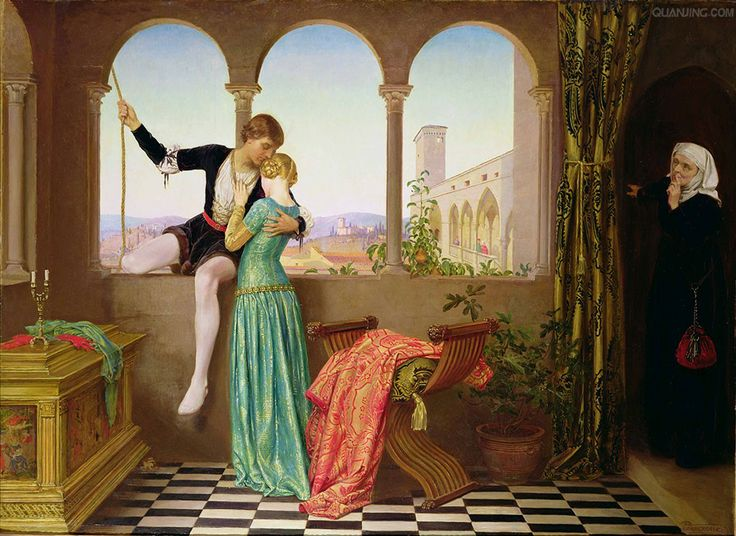

Painting of Romeo saying goodbye to Juliet while half climbing out of the window. He wears black and white, with a red belt, and has one leg out of the window. Juliet is in a blue-green dress with gold sleeves, her hair up in two plaited buns on either side of her head. She has her face buried in Romeo's neck, and he has one arm around her. The room has a black and white tiled floor, and on the left hand side is a gold painted casket with discarded cloths and a candlestick on it. A savanarola chair is in the centre of the room, with a green and gold tasselled cushion on it and a red and gold damask garment thrown over it. The window Romeo is climbing out of has three arches and no glass in it. The city can be seen through it. On the right hand side of the painting, behind a damask curtain that shuts off another room, the nurse can be seen in black with a white headdress, eavesdropping on the lovers.
Romeo and Juliet Farewell, Eleanor Fortescue Brickdale, 1905

His fame as a truly awful actor resulted in sometimes thousands of people flocking to see his shows. If theatre managers turned him down, he would bribe them. Claiming to be the best actor in the business, he would frequently forget lines, invent dialogue or entire scenes on the spot, and on one memorable occasion crawled around on stage looking for a dropped diamond buckle
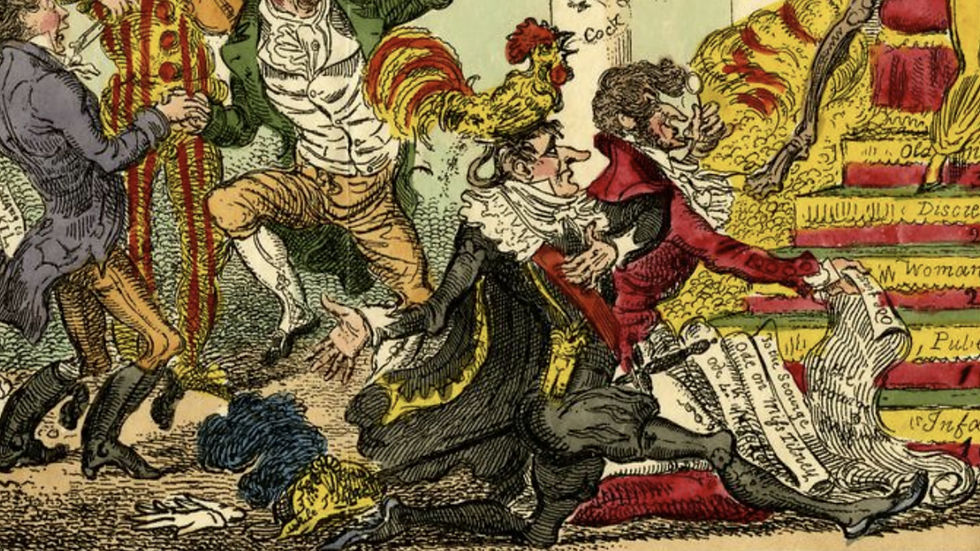

A detail of a hand coloured etching. In the foreground is a man in black, down on one knee, with the other leg extended in front of him. He wears elizabethan style breeches, and a flowing cloak trimmed with gold. His collar and cuffs are of lace, but he wears a fashionable regency cravat. A gold hat trimmed with blue feathers, and a pair of white gloves, are discarded behind him. On his head is a crowing cockerel. He is a caricature of Coates. Towards the background is a man in a red coat, and behind him two men are dancing. They're kneeling in front of some red and gold steps.
Detail, Princely piety, or the worshippers at Wanstead, hand coloured etching, George Cruikshank, 01/12/1811. Coates is shown in black, with a crowing cockerel on his head.

Whether or not Catherine Tylney Long, owner of Athelhampton, was remotely interested in his courtship is impossible to say, but he was frequently depicted alongside her other suitors in various caricatures of the time. In the detail below, his cock's head (a reference to his heraldry) is on top of the pole symbolising William Wellesley Pole, her eventual husband, with a dog representing the Duke of Clarence, another of her suitors, trying to climb up the pole. A white hen, probably representing Catherine, is near the top of the pole.


Detail of a caricature. Various people's heads are visible at the bottom, including on the right hand side the future William IV and his lover. In the centre on a mantlepiece, raised between two portrait frames (only one contains a portrait) is a pole, representing William Pole-Wellesley. At the top of the pole is a cock's head, representing Coates, and at the base of the pole is a dog with a human's head, representing the future William IV. Towards the top of the pole is a white hen, probably representing Catherine Tylney Long.
Detail, Princely amusements or the humors of the family, hand coloured etching, George Cruikshank, 01/03/1812

By 1816, audiences had got bored with mocking Coates, and he eventually died in 1848, aged 76, after being hit by a hansom cab outside the Theatre Royal in Drury Lane.
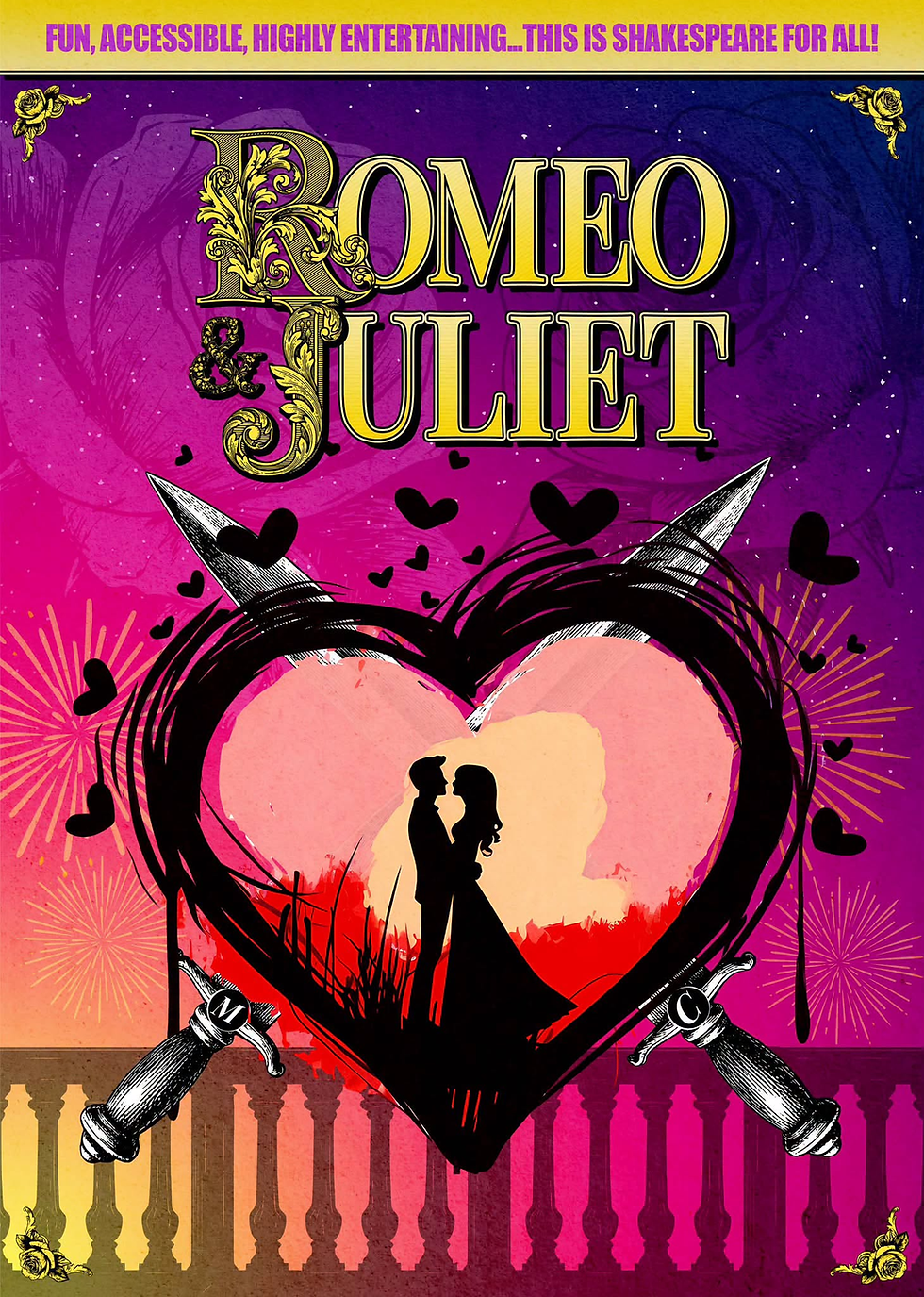

Poster for Romeo and Juliet, performed as outdoor theatre at Athelhampton House & Gardens. At the top, on a yellow band, in pink/purple text, is "FUN, ACCESSIBLE, HIGHLY ENTERTAINING... THIS IS SHAKESPEARE FOR ALL." The title "Romeo and Juliet is then in decorated yellow capitals against a background that shows a sky at dusk or dawn, with the stars still visible, going from deep blue/purple in the top right corner, through purple, pink, red, orange, and then to yellow in the bottom left corner. Superimposed on this at the bottom is the silhouette of banister rails on a balcony. Over the top is a pink and red heart outlined in black with the silhouettes of Romeo and Juliet embracing. Behind the heart are crossed daggers in black and white, one with an M at the hilt, the other with a C. The night sky background has a rose and fireworks gently superimposed on it, and there is an engraved yellow rose at each of the four corners.

We can never resurrect the bizarrely awful performances of Robert Coates, but Romeo and Juliet is still performed, despite his efforts. On the 11th of July, Immersion Theatre are bringing Romeo and Juliet to life at Athelhampton House & Gardens, without any of Robert "Romeo" Coates's antics to detract from the performance! Gates open from 6pm for picnics, and the performance begins at 7pm. Click here to book now.


bottom of page