
Jane Seymour's Crest in the Stained Glass at Athelhampton House & Gardens
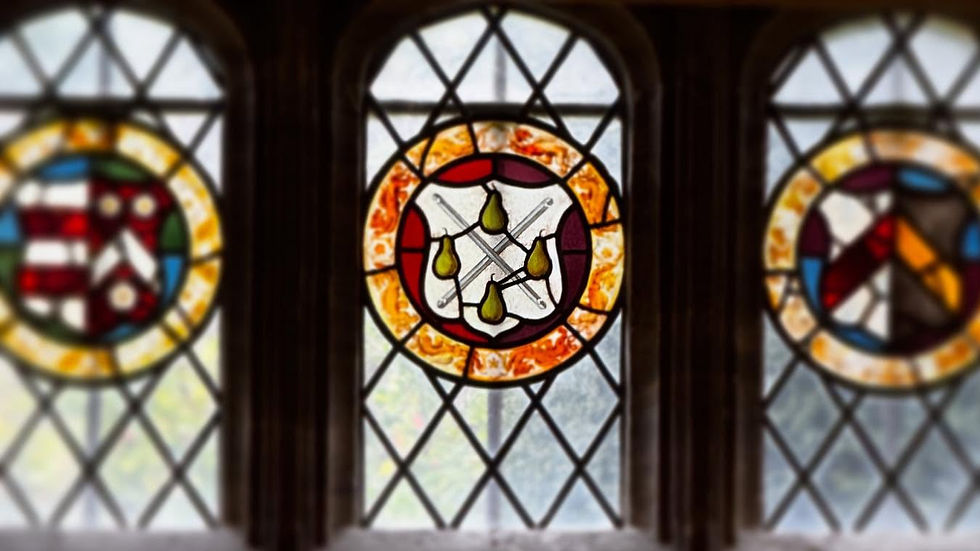
There's plenty of stained glass at Athelhampton House & Gardens, and much of it is originally medieval, or 16th Century. It's possible with almost all of it to identify the family it's connected to, and how they were connected to Athelhampton and the Martyn family, thanks to the coats of arms or crests shown.
In the Green Dining Room, though, we have a bit of a mystery. A fragment of stained glass survives in a roundel in one of the windows. These days it is faded to yellow and grey, but traces of where the colours were once vibrant reds, greens, and golds can be seen. But how old is it? And what does it show?

This fragment was once a crest that possibly sat atop a coat of arms, in a similar way to the crests that can be seen in the Medieval Great Hall at Athelhampton. It shows the silhouette of a bird rising up, though the bird has since been decapitated. The bird is rising from a castle, which has flowers growing out of it.
These flowers are Tudor roses in their true form, with the red petals surrounding white petals. The Tudor rose is a common motif in 16th Century designs, and can be seen elsewhere around Athelhampton.

The castle, the Tudor roses, and the rising bird all point to one specific crest: that of Jane Seymour, Queen of England and third wife of Henry VIII.

The Seymour badge was originally a peacock, but it was changed to a phoenix in the 1530s. Jane's badge shows a walled mound on top of another walled mound, with a crowned phoenix rising from flames, surrounded by flowers.
The Badge shows a grass mound and curtain wall on top of another mound within another curtain wall which has a towered gate and a crowned, fruited tree (said to be a Hawthorn Bush). On the very top, surrounded by flowers, is a crowned Phoenix rising from flames. In early depictions, these flowers seem to vary, including roses and carnations.

While being described by later researchers as having been done by an "indifferent draftsman," the below sketch labels the flowers as being two roses and two daisies, with a note reading "daisy. or columbine? rather ~ carnation" which gives an indication both of the skill of the original artist and the ability to identify flowers of the later viewer.

In later depictions of the badge, the flowers appear to just be roses, likely Tudor roses. On the lower mound in all depictions, a bush is shown growing. This may or may not be a hawthorn bush, a reference to Henry VII, who found Richard III's crown in a hawthorn bush at the end of the Battle of Bosworth. Commonly, the bush is crowned as well as the phoenix.

While incomplete, the crest shown in the window of the Green Dining Room at Athelhampton seems to indisputably show Jane's crest. The castle walls on two levels, the bush with a crown, the four flowers (in this case Tudor roses) and a bird rising up out of it all. In his Visitation to Athelhampton Hall, Alfred Carte de Lafontaine writes "Notice the arms of Jane Seymour in the south window." Quite what it's doing here, who put it here, and where it came from, we have no idea!
If you want to come to see the crest of Jane Seymour at Athelhampton House & Gardens, we're open 7 days a week all year round, except for a few days at Christmas. Come and visit, and see it for yourself!


