
Spot the Difference: Athelhampton House & Gardens and Max Gate
Visiting places like Athelhampton House & Gardens or Max Gate can be a wonderful way of seeing how fashions and tastes in domestic spaces have evolved over time. On a recent visit to Max Gate, we spotted all sorts of late Victorian things that make a nice comparison to things you can see at Athelhampton, both older and more modern.

In the dining-rooms, we're both late-Victorian but with the services laid out somewhat differently. At Max Gate, they've laid for a couple of courses along with soup and dessert...

Whereas Athelhampton has been laid far more simply, likely just for tea. The table lacks a tablecloth, showing off the regency carpentry.

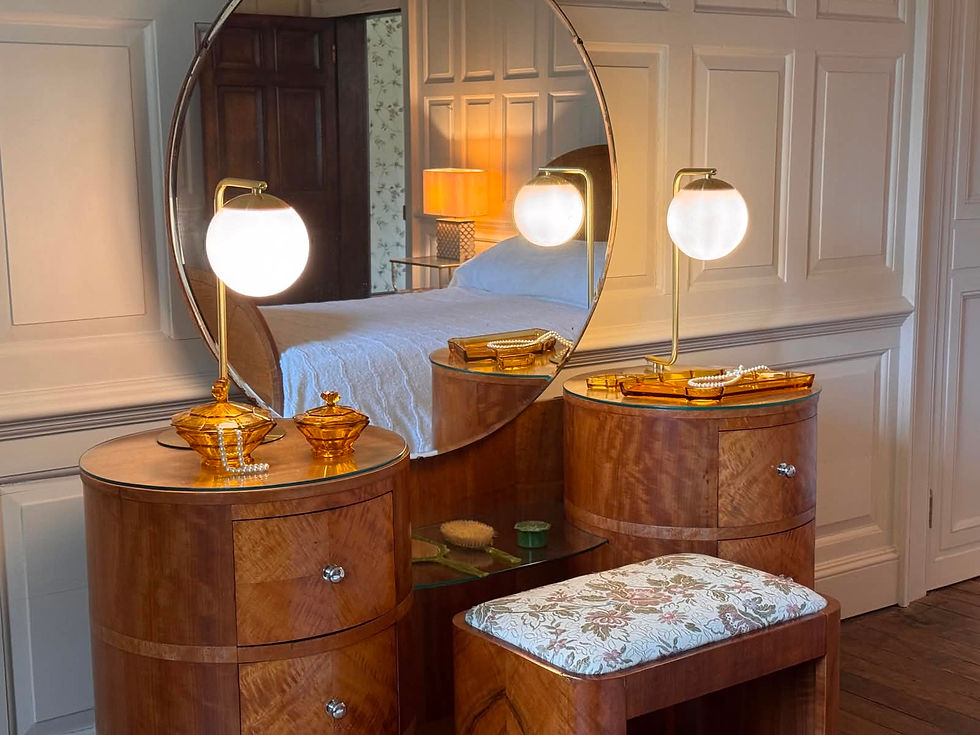
In the bedroom, a dressing table is a functional item of furniture that can reflect the owner's aesthetic, and the aesthetic of the time in which they lived. At Max Gate, the dressing table is solid and square, with little bits of ornamentation on the mirror stand, or around the edging of the drawers.

At Athelhampton, Peggy Harmsworth's dressing table is clearly Art Deco, with all the fashion of the 1930s geometry and ornamentation through decisive shapes. They're clearly the same piece of furniture, though, with the central mirror and space for hair brushes, along with drawers on either side. The lights on Peggy Harmsworth's dressing table at Athelhampton reflect her electrification of the house in the 1930s.
Max Gate was designed and built by Thomas Hardy, using his early architect's training. As such, it all dates to a single period, with even things like the tiles around the fire places reflecting the aesthetic tastes and technological capabilities of the Victorians: by this point, tiles were being mass produced in factories.

Many of the tiles in the fireplaces at Athelhampton are Dutch Delft tiles - tin glazed earthenware tiles, which from about 1625 tended towards being monochrome. Commonly they were blue and white, taking inspiration from Chinese pottery, but some of the sets of tiles at Athelhampton are in purple and white. These show biblical scenes, and date from somewhere between the mid C17th and 1800.
The designs on them were painted by hand, and at this point there was no way of mass producing them, though tile makers would speed up the process by pricking the design onto paper or card and then using "pounce," or chalk dust, to transfer the design onto multiple tiles.

Even the fireplaces themselves show differences in taste. At Max Gate, the fireplaces are smaller and more contained, with the mantle showing elegant and complex decoration.

Many of the fireplaces at Athelhampton, even the smaller ones, have very simple, stone arches framing them, and are backed with stone or brick, and a metal fireback. In this fireplace, the fireback commemorates the defeat of the Spanish Armada.

At present, Max Gate is closed on Mondays and Fridays, but open all other days.
Athelhampton House & Gardens are open 7 days a week all year round, aside from a few days over Christmas.


