
Stained Glass at Athelhampton House: Saint Martin de Tours
The focal point when looking at the stained glass at Athelhampton House and Gardens is often the ape. He is eye-catching, after all, and in some ways mysterious. Visitors exploring this historic Tudor house and gardens in Dorset are often drawn to the heraldic details and centuries of history found throughout the house. We will never know whether the Martyn family, who he belonged to as a heraldic crest, owned a pet ape, or whether he is merely symbolic. And the motto is arguably even more mysterious.

As such, the actual Martyn coat of arms often goes unnoticed. It's not like there's anything much to it after all - no pears to create a pun, like the Kelway family, no white roses like the Wadhams, and certainly not the complexity of quartering that we see in the Zouche of Harringworth arms in the library.
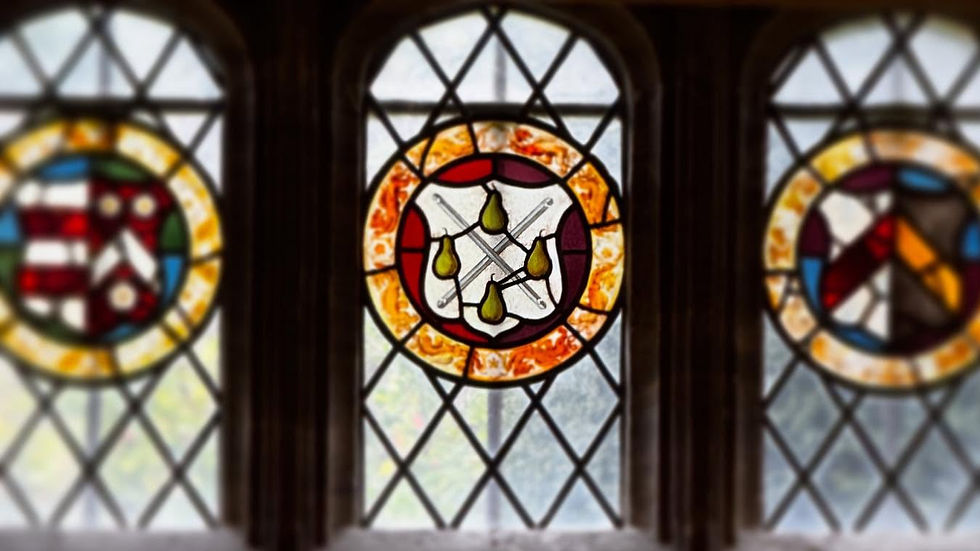
It's simply red and white stripes: three white, and two red, with no further ornamentation.
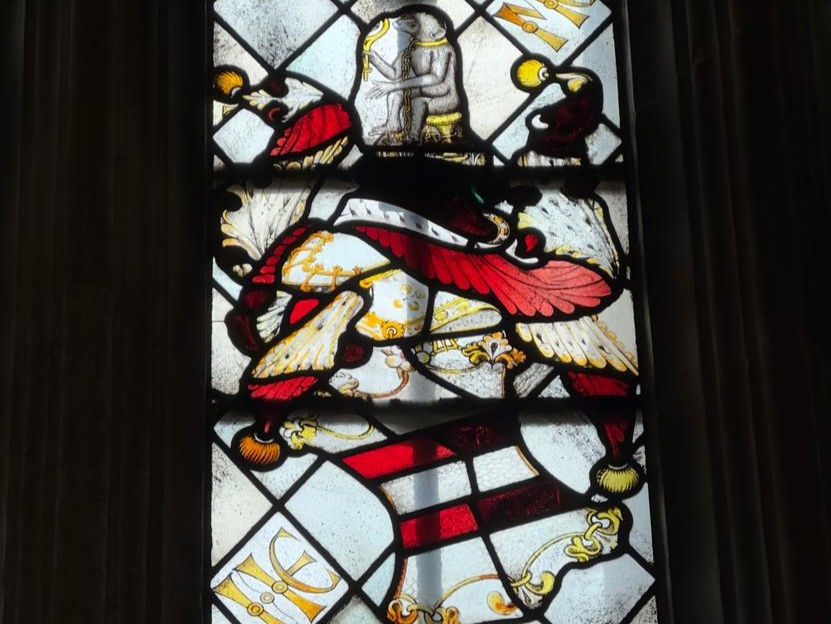
There is an argument to be made, though for a level of symbolism here that contains more historic layers than a simple pun, or declaration of allegiance in a civil war. The Martyn family of Athelhampton came across to England with the Norman conquest, descended from the Martyns of Turibus near Bayeux. Martin de Tours fought at Hastings with William the Conquerer, and so was granted land in England.

How much the family claimed descent from Saint Martin de Tours, a fourth century Roman cavalry soldier who converted to Christianity and became the third Bishop of Tours, it's hard to say. The fact that they cultivated possession of an identical name suggests that they were attempting to imply a degree of connection, and their coat of arms suggests a similar attempt to convey a connection.

The three white stripes, with one dividing two red stripes may seem simple and apparently meaningless, but they could well hold deeper symbolism. Saint Martin de Tours, when a soldier in the Roman army in Gaul, met a beggar as he was riding into Amiens. Impulsively, he cut his military cloak in half, and shared it with the man. That night, he dreamed of Jesus wearing the half of the cloak he had given away, and heard Jesus tell some angels that Martin had clothed him. This dream led to Martin being baptised.

Commonly shown in icons and in paintings as a red cloak, it could easily be argued that the Martin coat of arms shows a symbolic version of Saint Martin's red cloak divided in two to be shared with the beggar. We'll never know whether this really was the reason for the design of the coat of arms, but it seems quite a coincidence.

As an addendum - the actions of Saint Martin have left a couple of interesting etymological fossils in the English language. The part of his cloak that he kept became a relic preserved at Marmoutier Abbey near Tours: Frankish kings carried it into battle, and swore oaths on it. In 679, it's mentioned in the royal treasury as having undergone conservation.
The priest who cared for the cloak in its reliquary was called a "cappellanu," coming from the Latin for "little cloak," and this ultimately led to all priests serving with the military becoming known as such. From this came the French "chapelain," from which the English word Chaplain is derived.
Similarly, small, temporary churches were built for the relic when it was being moved about with the military. People called them "capella," again coming from the Latin for "little cloak." When small churches lost their association with the cloak, they retained the name, and so we know them in English as "chapels."
If you want to come and see the stained glass at Athelhampton, or the site of the Norman Chapel that used to stand here, we're open 7 days a week all year round.


