top of page

News from Athelhampton House & Gardens.

Search

Medieval Stained Glass at Athelhampton House & Gardens in Dorset.

Updated: 7 days ago

At Athelhampton House & Gardens, visitors can explore more than 20 historic rooms filled with original Tudor features. Among the most striking are the stained glass windows, which bring colour, craftsmanship and centuries of family history vividly to life.


Glass is integral to Athelhampton's history, and not just because of the windows that can still be seen today.
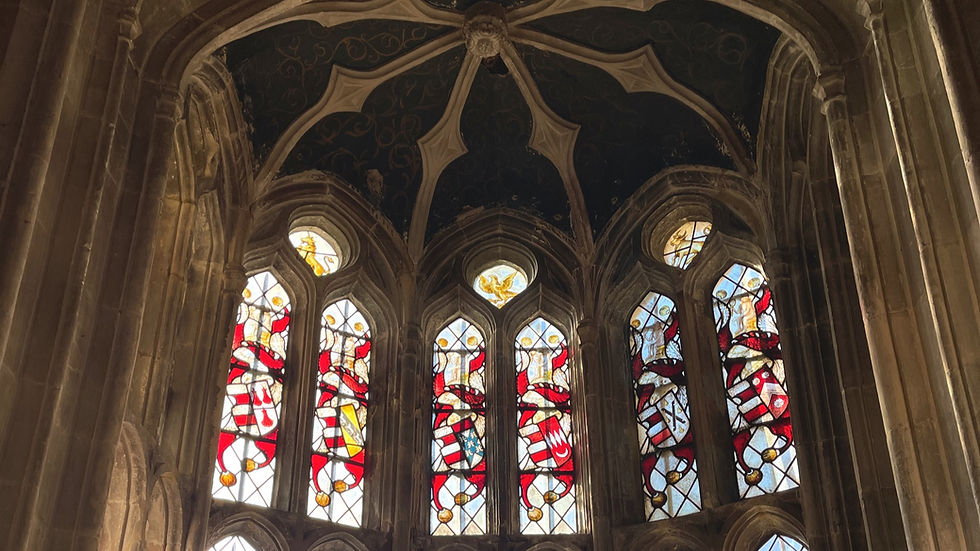

Stained glass in the oriel window at Athelhampton. Smaller circular windows at the top contain a yellow unicorn, eagle, and bull. Each has two tall windows below it showing a shield  surrounded by red and white plumes, crowned with a helmet sat on by an ape. Each shield is divided in two down the middle (impaled) to show the Martyn coat of arms on the left hand side (five horizontal stripes - white, red, white, red, white) and on the right, each of their wives' coats of arms. Left to right, these are: White ground with three red scallop shells - de Clevedon; yellow with a black stripe running diagonally top left to bottom right with three white unicorns running up it - Farringdon; a white background with a red band at the top, and a blue X with five white splodges on it - Cheverell; red background with four white diamonds in a band across the middle, with a white crescent underneath them - Daubney, a white background with four yellow-green pears separated by two black grozing irons crossing in an X shape in the middle - Kelway; a red background with a white chevron in the middle pointing upwards, with two white roses above it and one below - Wadham
Stained glass in the oriel window at Athelhampton

Stained glass manufacture in England dates back to at least the 12th century, and is an incredibly skilled craft that has changed very little over the centuries. For medieval stained glass, or indeed modern stained glass, a design first had to be created and agreed upon. Before paper became widespread, this design would be done to scale on a trestle table, using chalk or whitewash, with each colour represented by a letter or symbol. This life-size design could then be used as a guide to cut the glass and paint the glass, as well as ultimately functioning as a workbench on which to assemble the window. As paper became more common, life size paper cartoons were often created instead, which enabled glaziers to hand down designs over time.


A close up of the Martyn ape sat on top of each of the helmets above the shields in the stained glass of the oriel window. The ape is white/grey coloured, and has a big gold ring around its neck attached to a chain, which dangles down in front of it, between its legs, and then joins onto the yellow capstan type thing the ape is sat on. The ape is looking into a yellow framed mirror, and its snout is visible to the viewer. On either side of it, red and white plumes from the helmet are coming up and framing it. Below it, the top of the helmet can be seen.
The Martyn ape from the Tudor stained glass in the oriel window at Athelhampton House

The creation of the glass itself has also changed little over the centuries, though these days the process is far more industrial. Silica and alkali, when heated to sufficiently high temperatures and then cooled, become glass. Woodland ash was commonly used as the alkali in the medieval period, which resulted in glass that was more fragile and prone to breaking than modern glass.


An illuminated manuscript immage of a man blowing glass. He wears a green sheet and is sat on a red stool with green legs. He has the pipe for blowing glass in his mouth, and it's pointing towards the kiln on the right hand side of the image. His feet are also stretched towards the kiln. The kiln may have a cooling oven on the left hand side, closest to the glass blower. It also has four holes from which flames are coming. It's coloured yellow, and seems to be built of brick
Glass blower, from the manuscript De Universo or "De rerum naturis", Monte Cassino MS Casin 132, unknown artist, circa 1022-1032 (Given that glass melts between 1400 and 1600 degrees Celcius, I wouldn't want to be sat that close to the kiln!

The silica and alkali mixture would have powdered metallic oxides when they were being melted to give them different colours. Copper would give a very dark red, while cobalt would give blue, manganese for pink and purple, and iron oxides for greens and yellows.


Sheets of glass would be made by blowing it into a bubble and then flattening it out either by cutting it into a cylinder and opening it out, or by using centrifugal force to flatten it into a disk. These sheets of coloured glass could then be sold to stained glass painters, who would begin the next part of the process.
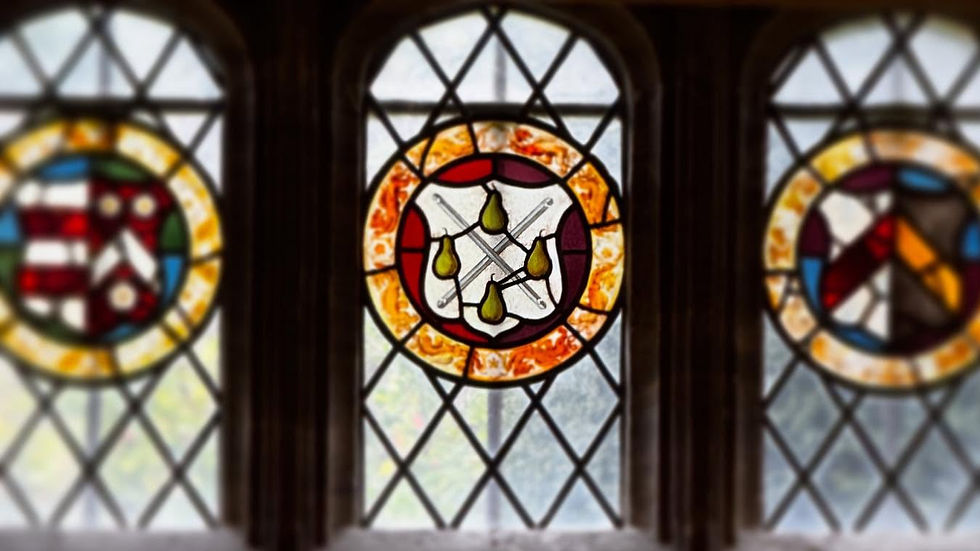

Glass in the Great Chamber at Athelhampton. The central roundel is in focus, showing a white shield with four pears and crossed grozing irons dividing them - the Kelway coat of arms. The background of the roundel is red, and it's surrounded by orange and white decoration as a border.
The Kelway coat of arms, with the grozing irons crossed, dividing four pears

The glass now acquired, the glazier would cut the glass according to the design. Grozing irons, which we can see crossed in the coat of arms of the Kelway family, were used as part of this careful process. Once cut to shape, the glass could then be painted. Glass paint, or vitreous, was made of iron or copper oxide, ground glass, and gum arabic, bound together with water, wine, or vinegar. This paint could be diluted according to the effect the painter wanted to achieve, and texture could also be added by scratching out the paint. To fix the paint to the glass, it all had to be fired.


A later version of the Martyn family's heraldic animal. This 16th century version has a grey ape seated on a capstan that it's chained to by the neck, gazing into a mirror that it holds in its right paw. The border of the roundel states: If you look at Martins ape - Martins ape will look at you - in English blackletter.
The Martyn ape in the stained glass at Athelhampton

The next step was assembly. The pieces would be laid out according to the design, and fitted into strips of lead called cames that could be soldered together. These thick black lines formed part of the design, as well as holding the window together as a single piece. To make the window completely waterproof, putty would be rubbed into any gaps, before the window was set into an iron frame to support its weight. At this point, the window could then be installed.


Stained glass put in in the 1960s. The top half of these windows show three shields, and the bottom part of the window has three scrolls. they show in turn, left to right: A shield cut into quarters diagonally, with the top and bottom triangles red and the two side triangles blue. Over the top is suspended a crown. The scroll beneath says ATHELSTAN. In the middle is a blue shield, on which is depicted a standing Virgin and Child in yellow. Over the top is suspended a Bishop's mitre. The scroll beneath reads SARUM. The right hand window shows a red shield with two lions passant guardant. Above is suspended a crown. The scroll below reads WILLIAM. Around each of these bits of stained glass the windows are in a lattice pattern, and decorated with A S and W randomly situated in each of the sections, along with either crowns or mitres according to which window it is.
Stained glass put in in the 1960s by the Cooke family

The works of art made using these complex techniques can be seen whenever you visit Athelhampton House. They weren't just used in the 16th century: some of our more modern stained glass at Athelhampton House from the 19th and 20th centuries was made using them too.


Athelhampton House & Gardens, in Dorset, is open 7 days a week all year round, except for a few days at Christmas, for you to visit our house, gardens, and restaurants. You can book tickets online here


The Great Hall at Athelhampton, looking towards the oriel window, which is on the right hand side of the picture. To its left is another window of four panels of stained glass, below which is a portrait of Henry VIII. In the centre of the room is a table on which sits a large wooden bowl full of hydrangea heads and a single candle stick. The floor of the hall is stone flags. The front door, which can just be seen on the left hand side, is carved wood and is open.
Stained glass in the medieval Great Hall at Athelhampton

bottom of page