
Linenfold Panelling when you Visit Athelhampton House & Gardens
When you visit Athelhampton House & Gardens, if you explore the house you'll come across linenfold panelling at every turn. To many people, that term means nothing, and it would have meant nothing to the medieval and Tudor craftsmen who created Athelhampton House, despite their familiarity with it as an object.
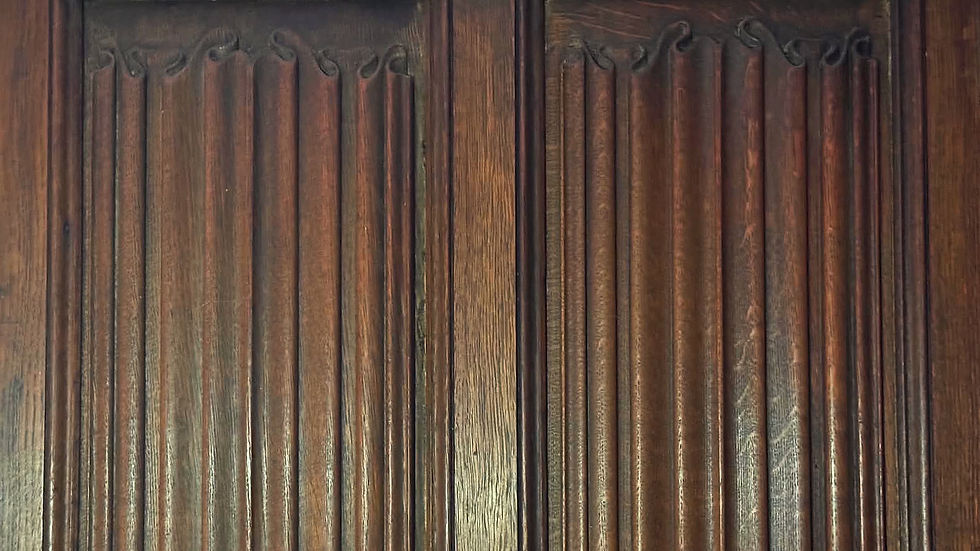
Linenfold panelling imitates folded linen or paper through relieve carving used on wood. While it originated in Flanders in the 1300s, it spread across Northern Europe through the following two centuries, and proved an incredibly popular way to decorate flat surfaces.

From simple carving that looks like a sheet of paper or linen folded in half and then opened back out again to the more complicated styles that look like a sheet of fabric folded back and forth many times, all linenfold panelling is created in the same way. A round plane is used to carve away the wood according to a predrawn pattern, and then a chisel is used at each end of the carved "fabric" to finish the ends. Stitched, embroidered borders could be faked by using a punch, though none of our linenfold at Athelhampton has such decoration.

As ever in the 16th century, regional variations appeared. England's linenfold is less delicate and less sharply defined than that of France and Germany. As the Renaissance progressed, linenfold panelling fell out of fashion, with interior design favouring either simpler styles, or styles with more "classical" influence, as the obsession with ancient Greece and Rome was increasingly reflected in material culture. That said, linenfold continued to be used (unfashionably) through the 17th Century.

When antiquarians like Alfred Carte de Lafontaine, owner of Athelhampton in the 1890s, began to revive Gothic and Tudor styles in the 19th century, linenfold began to reappear, and it was courtesy of some of these early antiquarians that it gained its current name. Before these antiquarians christened it linenfold, this panelling was known as lignum undulatum or "wavy wood".

Come and visit Athelhampton House & Gardens, and see how much of our lignum undulatum you can spot. It's worth looking closely: it's a good way to hide secret doors into other rooms. Athelhampton House & Gardens are open 7 days a week all year round, except for a few days at Christmas. Book online to save money, and if you're visiting this August, don't forget to take advantage of our partnership with Abbotsbury Subtropical Gardens to save 50% on your entry ticket to one of these venues if you've visited the other one!


