
Green Men in the Medieval Great Hall at Athelhampton House & Gardens
Fairly small and unnoticed, compared to the rainbow of the stained glass or the splendour of the roof, two Green Men sit above two doorways in the medieval Great Hall at Athelhampton House & Gardens.

We're not sure how old these two particular "foliate faces" are: they may be contemporary with the rest of the 15th century screen they're attached too, or possibly they were added by Alfred Carte de Lafontaine, when he sourced the screen in the 1890s. Either way, as part of the family of green men in England, they have a long history.

The green man was common in the 16th century as the English version of the Europe-wide “wild man,” and was used as a character at the head of pageants and parades to clear the way, for example when Maying at May-Day, or during the 12 days of Christmas.

In the early C20th the green man became conflated with paganism, but this has since been debunked. While a very romantic idea, the concept of there being underground "secret pagans" living in England through the medieval period into the 16th century is a modern invention courtesy of neopagans. Even the people accused of heresy or atheism in Medieval and Tudor England still believed in the Christian god (until, arguable, the very late Elizabethan period, when scientific thought from one or two individuals resulted in a couple of cases of "true" atheism in the modern sense). They were just the "wrong sort" of Christian, rather believing in different gods entirely.

In a very similar way, early modern women and men accused of or confessing to being witches were still operating in a very Christian framework - later ideas that they might have been pagan priestesses adhering to an ancient religion have again been thoroughly debunked.

Foliate faces, as these sorts of carvings are known, are likely to have originated in style in India, and have travelled across to Europe and England via the Arab empire. There are earlier examples of foliate faces in England from Iron Age Celtic and Roman art, but there’s no clear link from this time period through to their use in Christian churches: it doesn't start turning up in England until the late 11th century.

From decorating monks’ manuscripts, it spread to decorate churches. It wasn't snuck in by secretly pagan stonemasons: instead, it is a directly Christian motif, commissioned and specified (as every part of a costly building like a church or cathedral would have been) by the wealthy patron(s). In addition to the standard biblical stories, apocrypha and hagiographies through the medieval period saw Christian legends created. One of these centred around Seth, a son of Adam, and is contemporary with the rise of foliate faces in architecture and carvings.

As his father lay ailing, Seth went back to Eden, where the Angel with the flaming sword who cast his parents out of the garden invites him to look through the gates. There, he sees three visions: one of paradise, one of the tree of life dead with a serpent wound round it, and one of the tree of life revived, with Christ sat at the top. The angel explained that Adam must taste death, but gives Seth three seeds from the tree of life, instructing him to plant them beneath Adam's tongue once he is buried. Seth does so, and the tree that grows passes through the hands of a variety of biblical figures before ultimately being used to make the cross on which Christ was crucified.
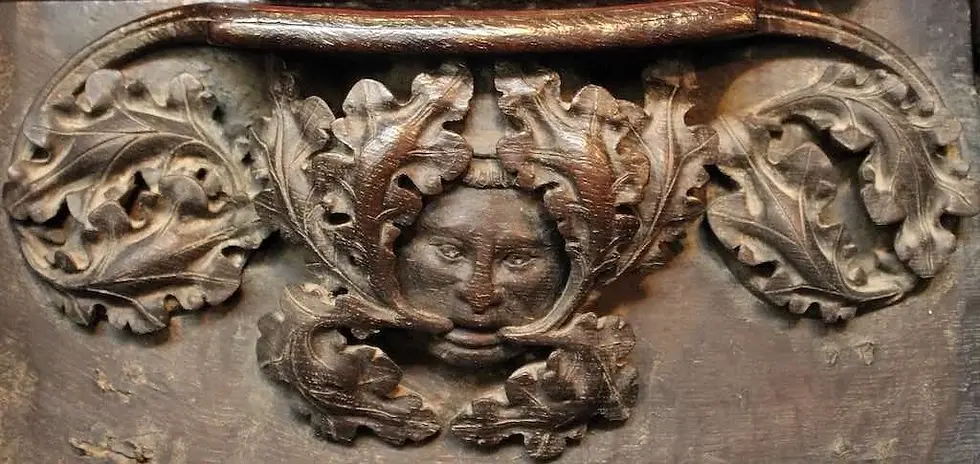
The green man featuring in churches and in medieval and Tudor architecture was a fashionable symbol in England, showing the commissioner's continental taste, while also showing mankind's promised salvation personified twice over - both in new life coming from Adam, and also in the source of the wood for the cross.

Come and visit to see the green men in Athelhampton's medieval Great Hall, and see if you can find any other creatures in the woodwork here. Athelhampton House & Gardens are open 7 days a week, all year round, aside from a few days at Christmas.


